Conquering the dreaded 7-9
One of my greatest challenges when running Powered by the Apocalypse (PbtA) games is the underspecified 7-9 result. A few examples follow, all from games I enjoy and admire:
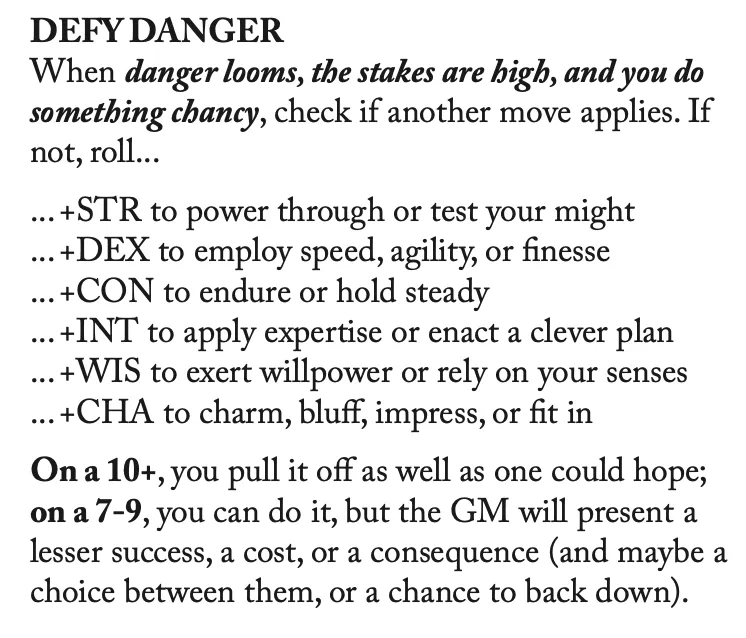
Stonetop's Defy Danger:
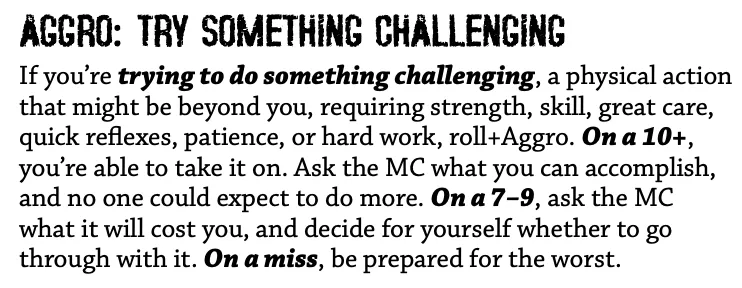
Apocalypse World: Burned Over's1 Try Something Challenging:
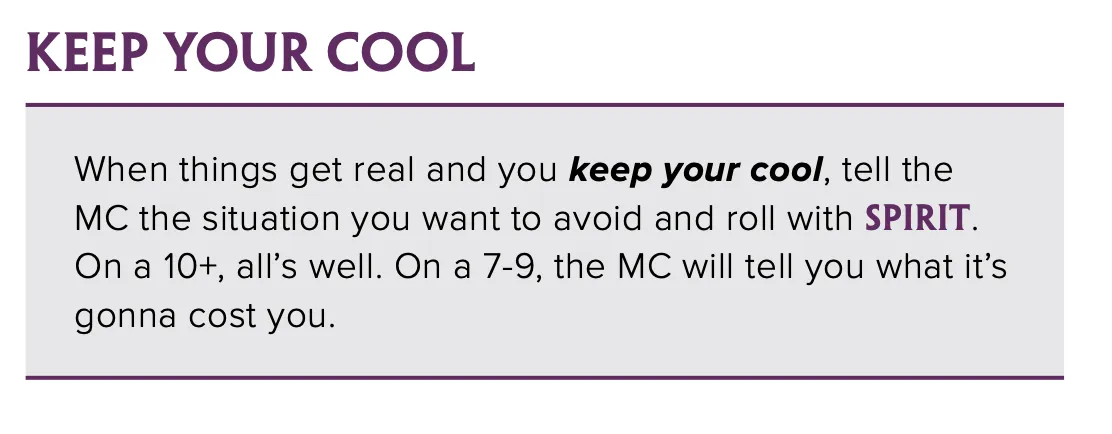
Urban Shadows 2E's Keep Your Cool:
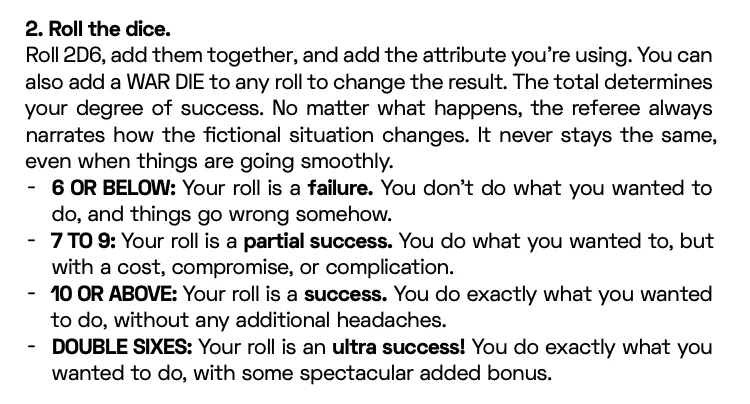
FIST's core mechanic:
I'm sure any PbtA GM has experienced this feeling of "what the hell do I do on a 7-9?" Forged in the Dark GMs may have had a similar experience on a 4-5 result in those systems.
This problem usually occurs when the move trigger is clearly met, but there is not a clear middle result. When one of these moves triggers, we have good tech for what should happen on a 10+ (the player pretty much gets what they want) or on a 6- (shit goes bad, make a hard move from the list or from your brain).
As an example, consider the following scenario for Stonetop. Anwen is carefully navigating a Stone Lord ruin in the middle of the Flats and while doing so, she has been chased by an long-dormant construct. As she flees from the stone golem, she comes to a gap where part of a balcony has fallen away. She braces herself to jump, and yep, it sounds like it's time to Defy Danger! Danger looms, the stakes are high, and she's doing something chancy.
An Example: Anwen in the Stone Lord Ruin
On a 10+, it's easy to imagine what happens. She jumps across, defiantly fleeing from the golem and making her way to safety. On a 6-, oh no - splat! Or, she hesitates and is caught. However, what might we say on a 7-9? We don't want to invalidate her success - most 7-9 moves say not that you fail but that there is a cost or consequence. I'd invite you to think for a moment - what would you say to Anwen's player if she rolled a 7-9?
Most people, I'd wager, might say something like "oh, she gets across but barely and is holding on with a white-knuckled grip." That is fine, as it goes - it's a lesser success. But to me, that still feels like invalidating the success. She let loose and jumped!
First, from the player perspective, this consequence contradict the player's fictional model. Depending on how far away she was, why wouldn't Anwen have been able to make that leap? Was the threat really clear to the player in the first place? Did they realize that this was a potential outcome?
On the GM side, even if the threat was clear, what should we do on that result? Does the "clutch the edge" result feel like a good middle-ground? How much did the GM have to think about this and interrupt the flow of play to get to this decision? I have often found that I get caught off guard by a 7-9 result and have to then improvise in ways that can sometimes feel unsatisfying or unnecessarily punitive, when I really should have set this possibility before I roll.
I know the argument for Stonetop (in particular) might be "the stakes should be high, so it should be possible to identify what this consequence might be." In practice, in the many sessions of that game I have run, I have not always found this to be the case. If you find the 7-9 easy to adjudicate, this post is not targeted at you!
The Solution: Deep Cuts
I am currently prepping a one-shot of Blades in the Dark, using the Deep Cuts revision John Harper published recently. In one optional rules module, Harper says the following:
When you make a threat roll, the GM describes a bad consequence that’s about to happen and you take action to avoid it. This way, everyone knows the possible outcome before the roll—you don’t have to create a new complication because someone rolled a 4/5. The risk/reward is established up front.
In the revised threat roll (which takes the place of the action roll in the original game), Harper has devised an elegant solution to this - when you roll a pool of d6s, the GM must describe a consequence that is about to happen, and the roll determines whether that consequence comes to pass. This game assumes the scoundrel is competent - the question is not "can you pick the lock?" but rather "can you pick the lock fast enough to avoid being spotted by the servants?" Once you roll, you get to assign dice out of your pool to avoid this threat.
I think a similar mechanism could be adapted to the problem of the 7-9 result, and here is what I will be trying tomorrow when I run a session of FIST:
- Before rolling, specify the goal of the character's action and a potential consequence they are simultaneously avoiding. If you can't specify a consequence, this means you shouldn't be rolling.
- On a 10+, the player achieves their goal and avoids the consequence.
- On a 7-9, the player achieves their goal but still suffers the consequence.
- On a 6-, the player does not achieve their goal and also suffers the consequence.
Revisiting our Anwen example above, here's how I might adjudicate that situation.
- Anwen's goal: escape the Stone Lord construct by leaping somewhere it can't reach easily. It's heavy, so hopefully even a small gap would be good enough.
- The consequence: Anwen ends up in a more precarious position - she might need to go into a part of the ruin that is unstable.
Now, we've set the stakes appropriately before we roll. If she rolls a 10+, great! If she fails, she finds herself in a more dangerous part of the ruin and the construct is still in hot pursuit. On a 7-9, we have a new, different problem, but it doesn't take Anwen's player by surprise or feel unfair. The player has a chance to ask clarifying questions about the nature of the consequence and remind the GM of relevant fictional positioning.
I'm curious if this post resonates with any PbtA GMs and I'm curious about how my solution feels to you, or if you've thought of other methods! Do let me know via whichever method you first found this post.
As of Dec. 5 2025 (time of writing), AW:BO! is on Kickstarter!↩