Bottom-up organization for RPG notes
Everyone who says how they know your RPG notes should be organized is wrong. Except for me.
In this post, I am going to outline a theory of bottom-up organization for RPG campaigns (for the GM). This approach is fast and intuitive, because at the end, it will reflect your own thought process so you can call to mind any NPC, fact, event, or location you need at a moment's notice.
In Games, Stuff Happens, and It's Fucked Up the GM Has To Remember It
I don't know if you've noticed, but when you run an RPG session, a lot of stuff happens. And, it is important for continuity and a sense of place that you remember what this stuff was. Common types of Stuff That Happen include:
- A PC reveals that their cousin from Lancashire was their childhood best friend, and now references them constantly. They have asked you to add this cousin to your next scenario.
- A dark power offers a bargain to a PC that you would never have imagined they would take. And, of course, they do - and now you have to a) remember that happened and b) think frantically about what the potential consequences should be.
- A bunch of probing questions from your players require you to make up some details about Rob's Convenience Store, a convenience store that, for some reasons, stocks only Pop-Tarts.
Personal Knowledge Management and You
If you, like me, have had the grave misfortune of wandering around the benighted realm known as Personal Knowledge Management YouTube1, you may have encountered the concept of the Zettelkasten, or slip-box2. I like Bob Doto's definition best, which I've reproduced here:
At the center of the system is the zettelkasten—an object and a practice—a thing and a way to do things. The term comes from German, usually translated as “slip box” or “note box,” less often, “card catalog,” terms with which you may be familiar. You may not, however, be familiar with German social scientist, Niklas Luhmann, who through his ability to publish a surprisingly large number of articles and books (at last count, roughly five hundred publications), brought to light his unique approach to taking, making, connecting, and leveraging ideas.
- Bob Doto, A System for Writing. p. 9. If you like any part of this post, I suggest you check out this book.
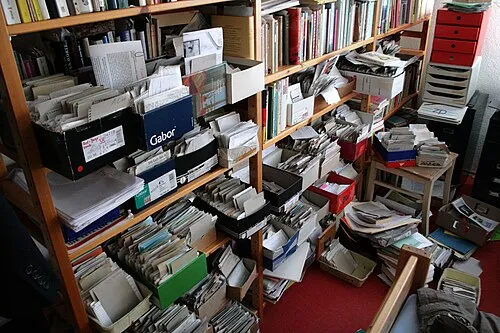
I maintain a Zettelkasten for my thinking. However, I only recently started developing smaller ones for RPGs and I am convinced this is The Right Way to make notes for an RPG.
The Technique
Here's how to make a Zettelkasten for your RPG campaign:
- Download Obsidian for free (or another note-making software that allows links)
- Make a note about something in your RPG file with the filename
DESCRIPTIVE TITLE HERE. Make sure the title is meaningful - the name of an NPC or location is usually fine for this purpose. 3 - Then, make another note.
- Link the two notes together, with a descriptive phrase that says why you've linked them.
- Repeat.
This is it. The whole technique. I'm going to devote the rest of this page to telling you why I think this is important and how to do it well.
Reasons Why This Is Good
The Slip-Box Has No Prescribed Hierarchy
The principal benefit of the Zettelkasten is its anarchic structure. The links between notes and thoughts invites one to use the chaos to one's advantage, rather than decide a priori what the structure of your notes should be. I agree with Soren Bjornstad on this topic that designing good hierarchies for storing knowledge is hard, and especially so for RPGs.
A hierarchy with a folder marked "NPCs" suggests that every single NPC you run across has equal weight, and therefore needs the same treatment. LegendKeeper, a tool I experimented with last year, does this via the affordance of templates, which assumes every NPC needs the same level of detail and should be kept in the same place in the folder hierarchy. But, not every NPC needs that much or even needs to be notated! A Zettelkasten is flexible, and can acommodate any kind of thing-worth-writing-down without needing a template or folder to put it in.
Linking Notes Is Generative
When you link notes together as the system suggests, you will find yourself making connections you did not expect. Crucially, you should always link a new note in your Zettelkasten to something else, even if it's not obvious. Since I number my notes (see footnote 3), I always link the previous note and one other. Being forced to link notes to each other has invited me to see connective tissue where I hadn't before, leading to more densely linked, interesting play.
Best Practices
Here are some things I've found it useful to remember when using this technique.
The obvious things should be individual notes, and they should be atomic.
You should have a note for each major NPC, for each player character, and for each major location. It is important that any given note only contains one of these things (this is what I mean by atomic) so it's easier to link them together and reuse things in new contexts.
Notes can also be facts
The first and most important thing to me is that notes can be facts. In other words, I make notes with a title that is a statement about the world that I wish to remember and link to other things. Here is an example from my ongoing Triangle Agency game:
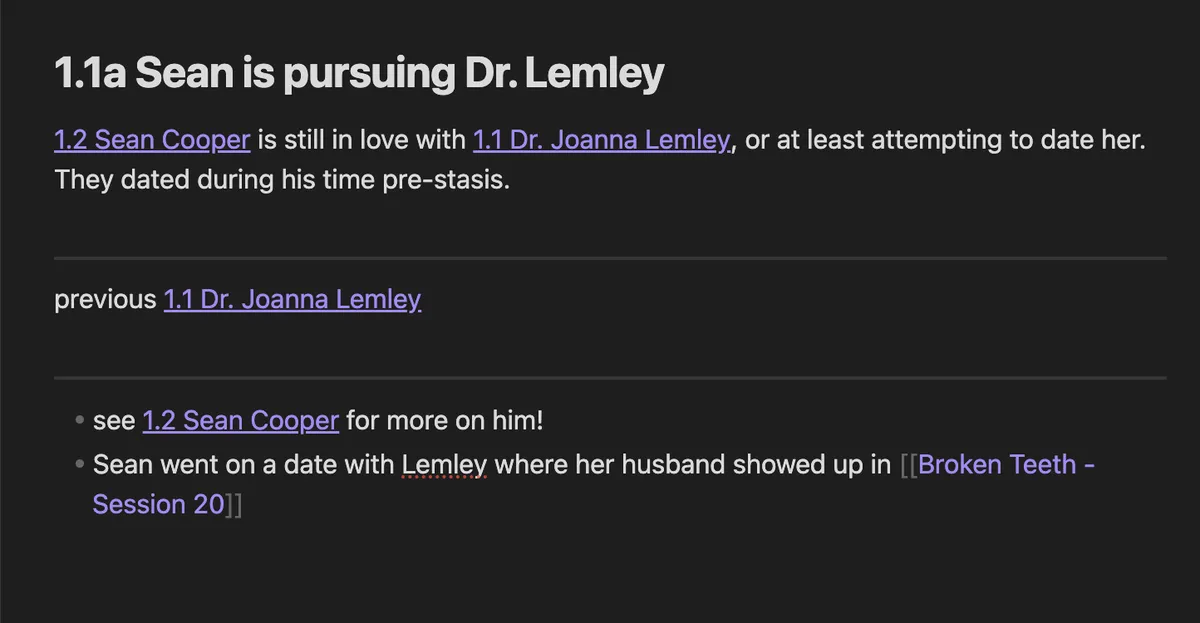
It is useful for me to have this written down as a note so I can bring this fact up to play, and link it to session notes.
Session notes are fleeting
A "fleeting note" is one that does not live in one's slip-box, but rather only sticks around long enough for you to write a main note that does live there. Session Notes serve this purpose. Session notes don't act well as permanent records because it's hard to remember what session, exactly, something occurred in. They are, however, great source for main notes where you notate relationships, new NPCs, or important facts about the setting you uncover during a session.
After a session, look through whatever notes you scrawled during a session (or your hazy memories thereof) and transcribe anything useful into your main note system, linking accordingl.
Some Useful Screenshots
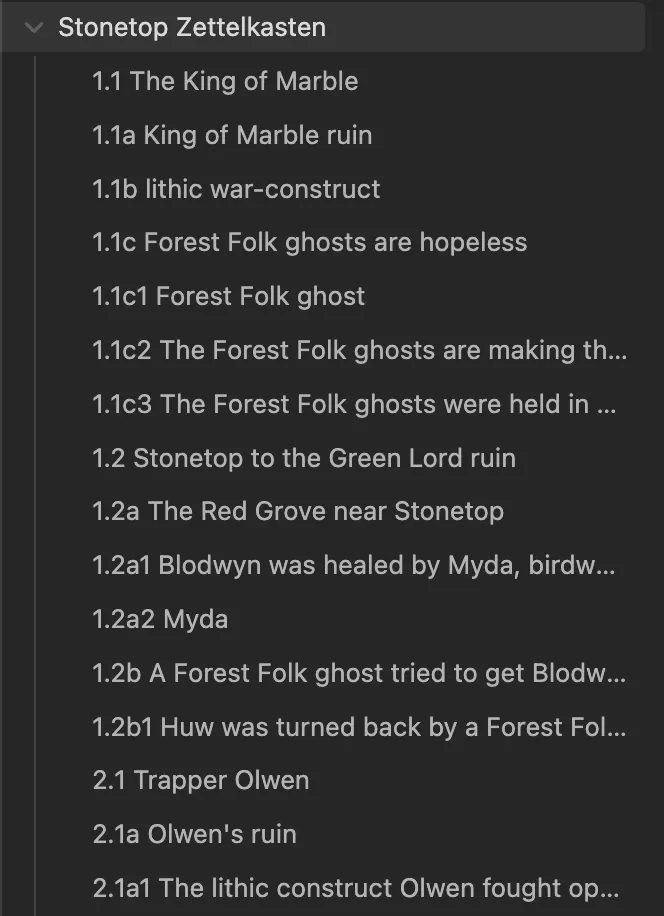
Here's what my folder of Stonetop-related notes looks like, giving some sense of the types of things I record:
Here's another Stonetop note:
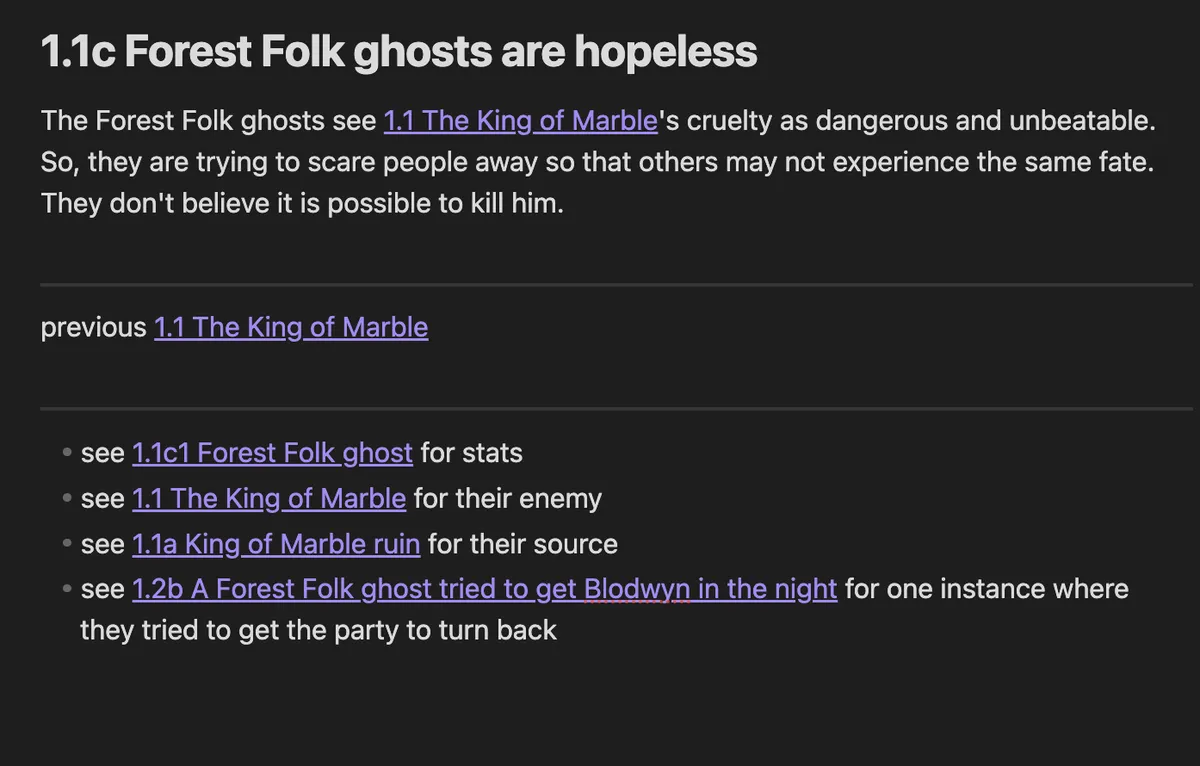
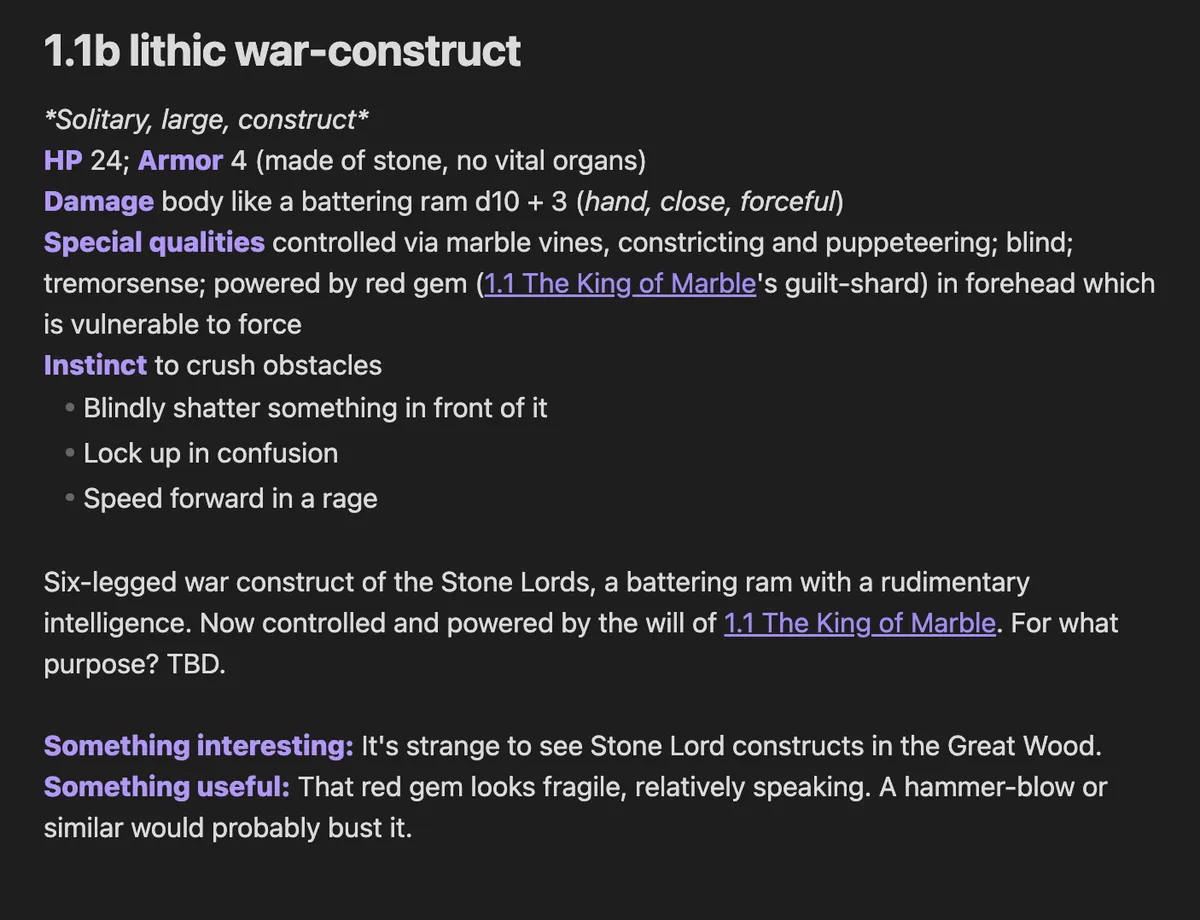
And this time with stats:
Conclusion
Try it out. If this advice feels alive to you and like it could be of use, give it a go!
It's interesting, isn't it, that the principle output of these YouTubers (think Tiago Forte or Justin Sung) is YouTube videos, not original scholarship or thinking... I have another post cooking about this.↩
I'll use both interchangeably.↩
I also suggest numbering your notes. The first note should be number 1.1. Then, when you make another one, number it 1.1a if it follows on directly from 1.1, 1.2 if it's more of a sibling thought, or 2.1 if it's unrelated. More on numbering at this link if you're interested.↩